Friday Feature Author Interview with Elise Cooper: Agents of Change: The Women Who Transformed the CIA by Christina Hillsberg

Book Description

Years after her successful and impactful career at the CIA, Christina Hillsberg became enthralled with the stories of the trailblazing women who forged new paths within the Agency long before she began her career there in the aughts. These were women who sacrificed their personal lives, risked their safety, defied expectations, and boldly navigated the male-dominated spy organization.

Through exclusive interviews with current and former female CIA officers, many of whom have never spoken publicly, Agents of Change tells an enthralling and, at times, disturbing story set against the backdrop of the evolving women’s movement. It was the 1960s, a “secretarial” era, when women first gained a foothold and pushed against the one-dimensional, pop-culture trope of the sexy Cold War Bond Girl. Underestimated but undaunted, they fought their way, decade-by-decade, through adversity to the top of the spy game.

Seamlessly weaving together the individual stories of these exceptional women, Hillsberg deftly tackles not just the fight for gender equality at the CIA, but the current dilemma the Agency faces when dealing with the culmination of a decades-long culture of sexual harassment and assault.

Each chapter sheds a light on women’s issues during that decade before bringing to life the stories of female CIA operations officers whose experiences were emblematic of that given era. In this fascinating and empowering chronicle, Hillsberg takes readers inside the Agency in a way that’s never been done before, paying long overdue tribute to the survivors and thrivers, the indispensable groundbreakers, and defiant rabble-rousers who made the choice to change their lives and in turn, changed history.

***

Elise’s Thoughts

Agents of Change by Christina Hillsberg reads like an espionage thriller. Hillsberg, a former CIA intelligence officer, uses her insider knowledge to write a nonfiction book about US patriots working for the CIA who happened to be women trailblazers. These women sacrificed their personal lives, risked their safety, defied expectations, and boldly navigated the male-dominated spy organization. The book profiles dozens of agents from the 1960s to the present.

The book takes readers behind the scenes as it explores by decade how women’s roles in the CIA evolved. The compelling exclusive interviews with those CIA officers show their resilience and determination.

They had to overcome the thinking of the times about women’s roles in the workplace. Although the book does discuss the fight for gender equality at the CIA, and the culture of sexual harassment/assault, this is not the essence of the book, but the riveting stories of how these women risked their lives while performing their duties that included doing espionage, recruiting spies, and stealing secrets.

One compelling story is of Marti Peterson. Marti served as an intelligence officer in Russia where she conducted dead drops. Because the KGB did not think that a woman would be used to conduct clandestine operations, she was able to collect foreign intelligence right under the Russians’ noses without them knowing. The description of her cover and how she went about her duties is riveting, especially after being captured by the KGB, betrayed by double agents.

Then there was Janine Brookner. She had her antennas up about Aldrich Ames who worked in counterintelligence alongside Janine’s ex-husband and long-time companion, Colin. She felt he was a security risk and brought her concerns up to the Chief of Station who ignored her. It turns out her concerns were justified considering eight years later, Ames would plead guilty to espionage on behalf of the Soviet Union. Unfortunately, she never received the credit for being one of the first people to identify him as a traitor.

A bonus is how Hillsberg makes the comparison between how the CIA treats female agents through the decades to what the James Bond films are doing with women in each decade.

Anyone who wants an espionage read should get this book. These women were groundbreakers, rabble rousers, but more important are the shields that helped to keep Americans safe.

***

Author Interview

Elise Cooper: Do you agree that those in intelligence should be thought of on July 4th, America’s birthday?

Christina Hillsberg: July 4th is a great time to take a moment and thank those that work in the shadows as well as all the servicemen and women in the military and law enforcement. There are so many incredible people behind the scenes to keep Americans safe, including the remarkable women I highlight in the book. The emphasis of those working at the CIA is to keep Americans safe here at home, abroad, and American interests. As Americans celebrate July 4th, I hope they remember why we have all these freedoms.

EC: How has your experience at the CIA helped you to write this book?

CH: We’re surrounded by so many misconceptions of the female spy, thanks in large part to Hollywood. I knew I was uniquely positioned to write a book about the real women in intelligence. Having spent time in both analysis and operations during my time at the CIA, I leveraged that experience to build trust with those I interviewed, many of whom had never spoken publicly about their CIA experiences.

EC: Why write the book?

CH: I wanted to write about the women who came before me and how the female spy has changed over the years, to amplify their stories and voices. It was meant to show the progress the Agency has made over the years regarding the role of women. There is also some conversation about the less favorable part of the history including the struggles of sexual harassment/abuse. That said, it’s meant to be a celebration of the incredible accomplishments of female officers at the CIA as well as the notable progress the spy organization has made throughout the decades.

EC: Why the book title?

CH: They were all trailblazers but considered troublemakers for making change happen. Even though the term should be intelligence officers I used the word ‘agents’ because of a play on words, they were the change agents. Originally the word ‘sisters’ was in the title but as I did the interviews and research, I realized there was no ‘sisterhood’ at the Agency although they opened the doors for other women. The sisterhood seems to come after we’ve left. I value the friendships I’ve made with these older women because they are filled with stories, wisdom, and experiences.

EC: It boggles my mind that Americans cannot thank personally those in the CIA for their service as we can with the military and law enforcement. Do you agree?

CH: Those at the CIA are bred not to speak of the accomplishments and to share. We always used to say in the CIA, there is only such a thing as “policy success and an intelligence failure.”

Many times, people do not hear about all the intelligence successes that happen all the time. If there is a success, the policy makers will take credit for it. Hopefully, with this book, Americans appreciate the role those at the CIA play in keeping them safe and become more aware of what they do. For example, Marti, a CIA officer, never told her children until they were much older that she was CIA. Many women of the CIA were quiet about their activities. Often these women did not share their stories even though they played vital roles in national security. I wanted to choose women who resonated with readers and to humanize them. To show how these women had families and had to make life choices.

EC: Why the James Bond comparison?

CH: When there is talk about the female spy the “Bond girl” comes to mind. Look at the trajectory of the Bond girl from the very first movie until now. It goes from a one-dimensional sidekick to a multidimensional very capable “Bond girl.” I thought it would be a great story telling structure to trace that along with the changing role of women through the decades at the Agency. It was my hope to write a book that is both entertaining and approachable for readers beyond history buffs and spy afficionados.

EC: Marti Peterson, a CIA woman who worked there in the seventies had an interesting career, do you agree?

CH: Absolutely. Marti began her career as a “CIA wife,” providing secretarial and administration support while accompanying her husband on his tour in Laos. She felt she was losing her own identity, an “appendage to his career.” After her husband was killed, she wanted to be an operations officer and refused the Agency’s offer to give her a secretarial role. Instead, she demanded more commensurate with her experience and abilities. At that time women were told they could not run operations, did not have the skill set, and were inferior. There was the fear they would get pregnant or marry and leave. But Marti was persistent, resilient, and determined to show what she was made of. She even learned Russian for a tour in Moscow where she was the first woman to operate clandestinely. She was an extremely accomplished woman whose experience helped shape the trajectory of women at the CIA for years to come. I’m grateful to have had the opportunity to sit down with her and hear about her career.

EC: What traits make women an advantageous spy?

CH: At the beginning of the book, I include an epigraph by an operations officer, “Don’t let somebody tell you, for whatever reason, you can’t do it because you’re a woman.” I think this is a powerful message to younger women, that nothing can hold them back. Because women were often underestimated, they leveraged that to their benefit, and by extension, the CIA’s as well. They blended into the background in male-dominated cultures across the globe, stealing secrets all while going undetected. Moreover, many women officers felt they were better listeners than their male colleagues, detailed oriented, more empathetic, could build rapport in different ways than the males, yet set boundaries.

EC: Were there any men supportive of these women?

CH: Oh, yes. Some women were fortunate to have supportive male colleagues and superiors, and in many cases, that meant the difference between a woman’s ability to attend operational training at the Farm or remain in a non-operational role at headquarters. Janine Brookner, for example, secured her first overseas assignment as a result of a male ally who advocated for a woman operations officer in his station. But once she arrived, it was up to her to prove her worth, and she did that in spades.

EC: Why did you highlight Janine Brookner?

CH: Even to this day people have strong feelings about Janine because she was so controversial. Having already passed away prior to my beginning my research for this book, I had to rely on interviews with family, friends, and colleagues to create Janine’s narrative. After hearing conflicting impressions, I realized that those who had something negative to say about her never worked with her directly, and yet, they criticized everything from her style of dress to her attitude. As with everything in life, everyone brings their own bias to the table, and it was my responsibility to wade through the noise and create the most accurate portrayal of Janine. And after dozens of interviews, I believe she was a smart and tenacious intelligence officer whose bravery created one of the most important watershed moments in the history of women at the CIA. After Janine was wrongfully accused of sexual harassment, she fought back and won. Although the CIA settled with her, the Agency did not admit any wrongdoing. The settlement said she had to resign. Because she knew this was just wrong, she became a lawyer to represent Federal government employees in their cases involving sexual discrimination.

EC: How would you describe Janine?

CH: I wish I could have met her, but unfortunately, she died. I would describe her as loyal, ambitious almost to a fault, resourceful, career oriented, empathetic, caring, excellent operational tradecraft, intuitive, and drive. She remained a close companion to Colin, her ex-husband and retired CIA case officer, who I’ve been fortunate enough to get to know throughout the reporting of this book.

EC: What do you want readers to get out of the book?

CH: I want readers to realize how important women are to national security. They are competent and talented officers who bring unique perspectives to all aspects of Agency work, a vital part of the mission. I want to encourage women to work in intelligence with their eyes wide open. I want to make sure that people celebrate the accomplishments of these women.

This not a book about an ‘axe to grind’ regarding sexual harassment and assault but rather, a book about the accomplishment of some remarkable women.

THANK YOU!!

***

BIO: Elise Cooper has written book reviews and interviewed best-selling authors since 2009. Her reviews have covered several different genres, including thrillers, mysteries, women’s fiction, romance and cozy mysteries. An avid reader, she engages authors to discuss their works, and to focus on the descriptions of their characters and the plot. While not writing reviews, Elise loves to watch baseball and visit the ocean in Southern California, with her dog and husband.

Friday Feature Author Interviews with Elise Cooper: The Guilty Sleep by Jeremy D. Baker and Nothing But Courage by James Donovan

Below is an interview with two authors who served in the military. They discussed their books, one a novel, The Guilty Sleep by Baker, and the other a non-fiction, Nothing But Courage by Donovan, as well as what Memorial Day means to them and how they incorporated their experiences into their books.

***

Book Description

Afghanistan vet Dexter Grant is broke, reeling from PTSD, and on the verge of divorce when he’s approached by his old Army buddies to help rescue their former interpreter, the man who once saved Dex’s life. It means ripping off a vicious queenpin’s drug proceeds—but not to worry, they have it all worked out. And if anyone can pull it off, it’s Dex’s former team lead, Staff Sergeant Saenz.

Tempted by an easy score that could make his own problems disappear and imbued with new purpose, Dex agrees to play his part in the scheme. But just as in combat, the best-laid plans don’t survive first contact with the enemy. When the heist goes off the rails, his wife and daughter become targets for bloody revenge. Dex must face down his spiraling inner darkness and call on all his strength and training to save his girls. In his quest, he’ll learn there was much more to this heist than he ever imagined.

###

Elise’s Thoughts

The Guilty Sleep by Jeremy D. Baker is a riveting novel. Although this book reflects on Baker’s past experiences, both professional, militarily, and personally, the story itself is a suspenseful mystery. The plot has the hero, Dexter, asked by his old army buddies to commit a crime to save the life of their former interpreter. Also, as part of the story, Dexter’s daughter has the same eye disease Strabismus, as the author’s daughter (essentially Lazy Eye), which costs tens of thousands of dollars to fix. He has no health insurance because he was kicked out of the military. He decides to go along with the heist to get the money for his daughter’s surgery. Dex is not a Rambo-type but is trying to do the right thing to make himself better to overcome PTSD. The book is about Dex coming back from war with his life falling apart and he decides to do something to make his life relevant again. After the heist goes off the rails, his wife and daughter become targets for bloody revenge, in which Dexter is determined to save.

***

Book Description

In June 1944, German and American forces converged on an insignificant bridge a few miles inland from the invasion beaches. If taken by the Nazis, the bridge might have gone down in history as the reason the Allies failed on D-Day.

The narrow road over it was each side’s conduit to victory. Continued Nazi control over the bridge near an old manoir known as La Fière—one of only two bridges in the region capable of supporting tanks and other heavy armor—would allow the Germans to reinforce their defenses at Utah Beach, one of the five landing areas chosen for Operation Overlord, the Allied invasion of Nazi-held Europe. But because control of the bridge was also essential to moving U.S. troops inland and off the beach, it could not simply be destroyed: it had to be taken—and held—by the Allies.

This was part of the formidable mission of the 82nd Airborne, whose lightly armed but superbly trained troopers had dropped behind—and into—German lines five hours before the seaborne assault on Utah. While blocking enemy reinforcements, they had to seize and secure avenues of approach from the beaches to the interior of Normandy, including two bridges over the modest Merderet River and the key crossroads village of Sainte Mère Église. Failure would give Hitler enough time, and the opportunity, to build up the resources necessary to defeat the invasion and turn the tide for the Nazis. The village was taken early on D-Day, and the 82nd endured repeated attacks by much larger German forces. But the bridge at La Fière became a bloody three-day standoff against tanks and artillery that culminated in a near-suicidal charge across it and the narrow 500-yard causeway beyond—straight into the teeth of a fierce German defense ordered to hold it to the last man.​

###

Elise’s Thoughts

Nothing But Courage by James Donovan tells the dramatic story of the courageous paratroopers and glidermen of the 82nd Airborne. They risked their lives to seize and secure a small, centuries-old bridge in France that played a pivotal role in the success of D-Day.

The battle for La Fiere was crucial in the Normandy invasion and afterward was led by Matthew Ridgway and James Gavin, two of the most outstanding commanders in American military history. In June 1944, German and American forces converged on an insignificant bridge a few miles inland from the invasion beaches. If taken by the Nazis, the bridge might have gone down in history as the reason the Allies failed on D-Day. Continued Nazi control over the bridge would allow the Germans to reinforce their defenses at Utah Beach, with supporting tanks and other heavy armor. But the 82nd Airborne’s success helped the allies in defeating the Germans on the Normandy beach.

This is a riveting, brilliantly researched account of one of the most overlooked yet heroic actions of WWII.

***

Jeremy D. Baker ————————— James Donovan

Author Interviews

Elise Cooper: Since Memorial Day is coming up what does it mean to you?

Jeremy Baker: Memorial Day, to me, means Remember. Remember the lives given in service of our nation. Remember those who sacrificed their all, who gave their last full measure of devotion, to something greater than themselves. Remember not only those who died in conflict, but those who died during times of peace, and those who died because of injuries–physical, psychological, emotional–that were received in times of war months or years before they died. Memorial Day, to me, means taking the time to honor all those we remember in these ways. It does not necessarily mean the day must be one of total, quiet, somber reflection. I’ve seen some people out there scolding their neighbors for having fun on the day, but in my mind, what could be a better remembrance and reflection of our values than using this sacred, special day for periods of enjoyment, family, community, and yes, even parties to kick off the summer season. Anyone who’s ever served will tell you that there are few things we service members enjoyed more than a good time with friends, a cold drink, and good food. I take absolutely no issue with anyone celebrating Memorial Day in the way they see fit, but I do hope everyone on the day will take at least a quick moment to think about those who gave their all for the rest of us. Every Memorial Day, I take a moment of reflection to think about those I served with who died, whether in combat, peacetime, or after leaving the military. I think about Carrie Ann, Josh, Dave, Brian, and Lee. The list grows over time, and even one name makes the list too long. I guarantee every veteran keeps a list like this in their mind. I’m honored to have served with these people, and their sacrifice, their battles, will not be forgotten.

James Donovan: Memorial Day is a time to reflect on those Americans who gave their lives to keep our country free. In writing this book I interviewed twelve men from the 82nd and thought what a great honor. By the time they made it back to England, after D-Day, they had 50% casualties: injured, missing, and dead. One company that originally had about 175 men returned with only 16 men. Memorial Day is not about the most recent war but about the past wars as well.

EC: Why the 82nd Airborne in the non-fiction book Nothing But Courage?

JD: It was a dream of mine to write a WWII book. The Airborne troops were considered elite Special Forces. Back then they did not really have Special Forces but had two elite parts of the Army, the Rangers and the Airborne. They were trained to a tee. They were given an assignment that lasted a week at the most and were sent back to regroup.

EC: What can you say about this mission?

JD: They were kept in the field for about 32 days. It was to seize and secure strategically important towns and bridges to keep German reinforcements out. Americans dropped two divisions of paratroopers behind the lines on Utah Beach on the French Coast. They were asked to take strategic towns, one of which was Ste-Mere-Eglise, that was controlled by the Germans. They also had to take two bridges to seal the Germans off from getting more men.

EC: Why were the gliders called in?

JD: They were sent in to take the La Fiere bridgehead on June 6th, 1944. They had to deal with the Germans who had machine guns, mortars, and anti-tank guns, basically well dug in. The paratrooper regiments were dropped all over because they lost their bearings. The

idea with glider troops of 20 to 30 men per glider was that they could jump out as a unit. For the most part it worked. After WWII they were not used because they used helicopters.

EC: Describe the leaders Ridgway and Gavin?

JD: General Matthew Ridgway was raised army, went to West Point. He was very inspiring and looked like a Roman Emperor. His deputy commander, Lt. General James Gavin, never went to high school, joined the army when he was 17, and went to West Point with an 8th grade education. He knew a lot about paratroopers. He led by example, very soft spoken. Ridgway was respected but Gavin was loved. These commanders were the first to jump out of the planes to lead their men, instead of how most generals acted, miles from the front. There was an extraordinary collection of men.

EC: Was it a success?

JD: Germans had flooded all these fields. They had to jump in the Swamp Land where dozens of men drowned. Yet, they got the job done because of the leadership, extraordinary training, and courage. After this, Airborne men proved that they could do an astonishing job.

EC: Does this story, The Guilty Sleep, have any reflection on your past service?

JB: I have been writing off and on for about twenty years. There is an awful lot of me and my military experience in this story. What I really wanted to do with this story is talk about the cost of fighting wars. I thought about this story in August of 2021 when the US was pulling out of Afghanistan. It was immediately overrun by the Taliban. As a military veteran who had served there, I had a lot of thoughts and feelings about it. I had a lot of conversations with other veterans about it. It made all the sense in the world to take all my thoughts and feelings about what happened there and put it all together in a novel that also dealt with family, camaraderie, and the cost of fighting wars on those who have fought.

EC: How did your military experience help you to write this?

JB: I was a counterintelligence agent in the army from 2000-2005, serving in Afghanistan. My team was assigned to support the Special Forces team, so we spent a lot of time chasing down the Taliban and Al Qaeda. In many ways there are elements in this story based on my personal experiences. The main character, Dex, is also a counterintelligence agent who was deployed there. He had the same training I did with many of the same experiences. He was impacted with combat induced PTSD that he developed during his deployment.

EC: Why the book quote, “The draw down in Afghanistan and the Taliban coming back is like nothing that happened even mattered. Like they died for nothing.” Please explain.

JB: I started writing this book in October 2021 and we pulled out of Afghanistan in August of 2021. I was watching it as a civilian and saw how our Afghan allies fled, and the Taliban took over our equipment. We were there for almost twenty years and so much of the blood and treasures died. I was struggling with what was it all for. There was a scene in the book where there was a veteran support group from Vietnam to Afghanistan. They talked about the Afghan pullout.

EC: How would you describe Dex, the hero?

JB: He is unraveling, a lost soul, sarcastic, a stand-up person, and a loving husband/father.

EC: Why give him PTSD?

JB: Some people who had one deployment like me struggle with PTSD and some people have many multiple deployments and do not seem to struggle with PTSD. Fighting wars and being in combat does have an impact on the human psyche. I found writing was my therapy.

EC: What was the character Dex struggling with?

JB: He had PTSD and struggled with depression, alcoholism, loss, and possibly losing his family. He screams, curses, has fury, some uncontrollable behavior, and sleep deprivation. I drew a lot of his PTSD experience from my own, especially the unexplainable flashes of rage along with the tossing and turning and unable to sleep. But like Dex I was a devoted husband and father. I put in this quote, “anger, booze, nightmares, symptoms, must be cut out like a tumor. And do it by helping people who need help.”

EC: Next book?

JB: I am working on sequel to the book. There will be some characters back. The working title is The Guilty Burn. There is no release date. Dex helps someone who gets into trouble and will do problem solving together.

THANK YOU!!

***

BIO: Elise Cooper has written book reviews and interviewed best-selling authors since 2009. Her reviews have covered several different genres, including thrillers, mysteries, women’s fiction, romance and cozy mysteries. An avid reader, she engages authors to discuss their works, and to focus on the descriptions of their characters and the plot. While not writing reviews, Elise loves to watch baseball and visit the ocean in Southern California, with her dog and husband.

Feature Post and Book Review: Anywhen by Beth Duke

Book Description

Baezy is born in 2069, the centennial of the legendary Woodstock Music and Art Fair. Everything peace, love, and flower power is celebrated that year in a wave of nostalgia that takes over fashion, music, and the public’s imagination. She grows up listening to and loving the artists of that time, dreaming of witnessing everyone from Joan Baez to Santana in person. When presented with the opportunity to time-travel, Baezy immediately chooses Woodstock as her destination. She plans to enjoy a glorious weekend of vibrant sights and sounds; her bell bottoms and a peasant blouse are packed for the adventure and she’s excited to surprise her great-great-great-grandmother, Kelly Adams.

While Baezy’s certainly not a typical Woodstock attendee, Kelly isn’t either. She is at the very beginning of a stellar career researching artificial intelligence in the 1960s, and will later develop much of what will lead to the utopian society Baezy lives in. Kelly’s future family is immensely proud of her historic accomplishments.

The contrast between Baezy’s 2101 and 1969 is stunning from her first moment. Woodstock exceeds her wildest expectations, but holds far more than an introduction to her distant grandmother. Baezy quickly finds herself in life-altering situations she could never have anticipated.

Goodreads: https://www.goodreads.com/book/show/220605667-anywhen?ac=1&from_search=true&qid=J1xDbP33VR&rank=1

***

My Book Review

RATING: 4 out of 5 Stars

ANYWHEN by Beth Duke is a mash-up of genres; time travel, historical fiction, romance, and sci-fi all centered around time traveler, Baezy, who assumes the name and identity of Sarah while in the past.

Baezy was born in 2069, which is the centennial of the legendary Woodstock Music Festival and is named after the singer Joan Baez. Baezy is excited that for her birthday in 2101, her mother has arranged a three day TIP (Time Insertion Protocol) for her to travel back to Woodstock in the year 1969 not only for the live performances she has studied and loves, but to also meet her three times over grandmother on her maternal side, Kelly Adams, who was a brilliant mathematician at MIT and an originator of AI.

While Baezy’s time insertion does not go exactly as planned, she is able to find the group of six that have gone to Woodstock together including Kelly. Baezy is very excited to meet Kelly, but their interactions lead to problems. Her naivety, beauty, and lack of complete understanding of 1969 slang and sayings leads her into conflict with Kelly’s group except for Jack, who is a teacher and sympathetic to Baezy’s differences. Baezy hopes to avoid the others and just enjoy the rest of the Woodstock performances with Jack, but every decision she makes could lead to future changes she could never anticipate.

I enjoyed the mixed genre plot throughout this story very much. The time travel, the futuristic Unity and the historic Woodstock, also with discussions of the Vietnam war were all well written. Unity may have no war or hunger, but it is still not a future I would hope for. The scenes of Woodstock are entertaining and nostalgic. I loved Baezy and her emotional awakening and evolution throughout the story, it was Kelly and the females in the travel group that I found immature for their ages and off-putting, so much so that I almost put the book down for good. I am glad I carried on though for the remainder of Baizy’s storyline.

This is a story that will capture many differing types of genre readers and satisfy them all.

***

About the Author

Beth Duke is an Amazon #1 Best Selling Author and the recipient of numerous honors for her fiction on two continents.

She is eyeing the other five.

Her book TAPESTRY was the Bronze Medal Winner in Southern Fiction in Publishers’ Weekly’s 2020 Readers’ Choice Awards, an Award-Winning Finalist in the 2020 International Book Awards, and a Five Star Readers’ Favorite Award Winner.

Beth lives in the mountains of her native Alabama with her husband, Jay, and an assortment of dogs—including a recently-rescued coonhound named Daisy who has stolen her heart. Beth is the adoring and proud mother of Jason and Savannah. She is a constant reader, travel aficionado, and likes to pretend she’s in baking competitions.

She also finds great joy in joining book clubs for discussion (usually via Zoom). If your group would like to schedule a date, please email beth@bethduke.com.

Her books DELANEY’S PEOPLE, DON’T SHOOT YOUR MULE, IT ALL COMES BACK TO YOU, TAPESTRY, and DARK ENOUGH TO SEE THE STARS are all love letters to her home state.

Social Media Links

Website: https://www.bethduke.com/

Facebook: https://www.facebook.com/bethidee

Instagram: https://www.instagram.com/onlythebethforyou/

BookBub: https://www.bookbub.com/authors/beth-duke

Book Review: On Call: A Doctor’s Journey in Public Service by Anthony Fauci, M.D.

Book Description

Anthony Fauci is arguably the most famous – and most revered – doctor in the world today. His role guiding America sanely and calmly through Covid (and through the torrents of Trump) earned him the trust of millions during one of the most terrifying periods in modern American history, but this was only the most recent of the global epidemics in which Dr. Fauci played a major role. His crucial role in researching HIV and bringing AIDS into sympathetic public view and his leadership in navigating the Ebola, SARS, West Nile, and anthrax crises, make him truly an American hero.

His memoir reaches back to his boyhood in Brooklyn, New York, and carries through decades of caring for critically ill patients, navigating the whirlpools of Washington politics, and behind-the-scenes advising and negotiating with seven presidents on key issues from global AIDS relief to infectious disease preparedness at home. ON CALL will be an inspiration for readers who admire and are grateful to him and for those who want to emulate him in public service. He is the embodiment of “speaking truth to power,” with dignity and results.

Goodreads: https://www.goodreads.com/book/show/207689829-on-call?ac=1&from_search=true&qid=yvggfGYUwz&rank=4

***

My Book Review

RATING: 4 out of 5 Stars

ON CALL: A Doctor’s Journey in Public Service by Anthony Fauci, M.D. is the autobiography of the most interesting public health doctor/scientist who has served this country for many decades. Stories from his personal life and friendships, his dedication to medicine and public health, and his attempt to remain politically neutral while having his and his families’ lives threatened are all interwoven in a timeline that covers many of the epidemics that have plagued the world in the last sixty years.

I was especially interested in reading about his time working to protect the public from both HIV/AIDs and Covid, two terrible infectious diseases that affected many friends and made me fearful for family. His writing about his personal life is entertaining and I found the entire book fascinating, even though it is in certain places heavy with the science of statistical trials, microbiology and immunology which I did slightly slide through, but he is a man of science, and I am sure other students of public health, medicine and science will find it more important and enlightening than I did.

This is an autobiography of a truly dedicated, compassionate, and brilliant public servant that is worth reading. Thank you for your service, Dr. Fauci.

Feature Post and Book Review: Bookshops and Bonedust by Travis Baldree

Book Description

Viv’s career with the notorious mercenary company Rackam’s Ravens isn’t going as planned.

Wounded during the hunt for a powerful necromancer, she’s packed off against her will to recuperate in the sleepy beach town of Murk—so far from the action that she worries she’ll never be able to return to it.

What’s a thwarted soldier of fortune to do?

Spending her hours at a beleaguered bookshop in the company of its foul-mouthed proprietor is the last thing Viv would have predicted, but it may be both exactly what she needs and the seed of changes she couldn’t possibly imagine.

Still, adventure isn’t all that far away. A suspicious traveler in gray, a gnome with a chip on her shoulder, a summer fling, and an improbable number of skeletons prove Murk to be more eventful than Viv could have ever expected.

Goodreads: https://www.goodreads.com/book/show/65213543-bookshops-bonedust?ac=1&from_search=true&qid=TSlV6IQiaS&rank=1

***

My Book Review

RATING: 5 out of 5 Stars

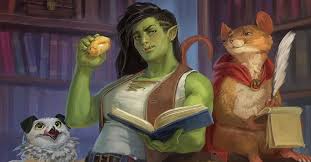
BOOKSHOPS & BONEDUST (Legends & Lattes Book #0) by Travis Baldree is an enchanting and delightful cozy fantasy prequel to Legends & Lattes. This story is a wonderful blend of Viv’s journey of personal self-discovery, humor, and fantasy action/adventure plot. This is not my usual type of read, but I found I could not put it down.

Viv is a mercenary orc on her first big hunt with Rackham’s Ravens to take down a powerful necromancer. When she is wounded in battle, she is left behind to recuperate in the small seaside town of Murk. Having always focused on her battle skills, Viv is at a loss on how to fill her recovery time.

She discovers a run-down bookshop with a foul-mouthed book-loving owner who introduces her to a love of reading and a journey of discovery between the covers of each new book. Even as she makes new friends, a darkness threatens that could endanger everyone she is coming to care for.

I love this group of strong female characters. While they are orcs, gnomes, and other fantasy characters, at times while I was engrossed in the story, I would forget they were not human. This is primarily Viv’s story. She is a mercenary orc on her first big hunt, but when she is injured, she is left to recuperate in a small seaside town. She discovers the joy of reading, her first romantic relationship, and her first real friendships all while a threat of evil threatens. Mr. Baldree’s writing brings Viv and the entire cast of characters to life beautifully. The suspense elements of the story are perfectly paced and kept me turning the pages. This book is a perfect mix of self-discovery, friendship, humor, suspense and action/adventure. FYI: This story does have a female orc and female gnome romantic relationship which is why it is classified as an LGBTQ read.

I highly recommend this wonderful cozy fantasy and I am looking forward to reading more stories by this author.

***

About the Author

Travis is a #1 New York Times Bestselling author, a Locus, Nebula, and Hugo finalist, and a full-time audiobook narrator who has lent his voice to hundreds of stories. Before that, he spent decades designing and building video games like Torchlight, Rebel Galaxy, and Fate. He lives in the Pacific Northwest with his very patient family and their small, nervous dog.

Social Media Links

Website: https://www.travisbaldree.com/

Facebook: https://www.facebook.com/travis.baldree

Twitter: https://twitter.com/TravisBaldree

BookBub: https://www.bookbub.com/books/bookshops-and-bonedust-by-travis-baldree

Friday Feature Author Interview with Elise Cooper: Human Game by Simon Read

Book Description

In March and April of 1944, Gestapo gunmen killed fifty POWs—a brutal act in defiance of international law and the Geneva Convention.

This is the true story of the men who hunted them down.

The mass breakout of seventy-six Allied airmen from the infamous Stalag Luft III became one of the greatest tales of World War II, immortalized in the film The Great Escape. But where Hollywood’s depiction fades to black, another incredible story begins . . .

Not long after the escape, fifty of the recaptured airmen were taken to desolate killing fields throughout Germany and shot on the direct orders of Hitler. When the nature of these killings came to light, Churchill’s government swore to pursue justice at any cost. A revolving team of military police, led by squadron leader Francis P. McKenna, was dispatched to Germany seventeen months after the killings to pick up a trail long gone cold.

Amid the chaos of postwar Germany, divided between American, British, French, and Russian occupiers, McKenna and his men brought twenty-one Gestapo killers to justice in a hunt that spanned three years and took them into the darkest realms of Nazi fanaticism.

In Human Game, Simon Read tells this harrowing story as never before. Beginning inside Stalag Luft III and the Nazi High Command, through the grueling three-year manhunt, and into the final close of the case more than two decades later, Read delivers a clear-eyed and meticulously researched account of this often-overlooked saga of hard-won justice.

***

Elise’s Thoughts

Memorial Day honors and mourns those military personnel who died while serving their country.  After watching the movie “The Great Escape” people might want to honor those in the allied armed forces who were captured by the Germans and brutally killed. Immortalized in the film is the mass breakout of seventy-six Allied airmen from the infamous Stalag Luft III.  Not long after the escape, fifty of the recaptured airmen were taken to killing fields throughout Germany and shot on the direct orders of Hitler.

People might wonder what happened to these Nazi killers. In the book Human Game, Simon Read delivers a clear-eyed and meticulously researched account of this often-overlooked saga of hard-won justice. This “after story,” starting where the movie left off, explains in detail how the German Gestapo killers were brought to justice.

When the nature of these killings came to light, Churchill’s government swore to pursue justice at any cost. Francis P. McKenna led a three-year manhunt that brought twenty-one Gestapo killers to justice.

***

Author Interview

Elise Cooper: Which came first the movie, “The Great Escape,” or your idea to write the book?

Simon Read: The movie came first.  I am from the UK originally. There, it is a tradition that they show “The Great Escape” movie every Christmas Day. My grandfather flew with the Royal Air Force during the Second War. From a very early age I used to sit with him and watch.  It is still one of my favorite movies of all time.  I was always traumatized by the ending where the escapees were gathered in a field and machine gunned down. I wondered what happened to the Nazi who gunned all the escapees down. This was the genesis for the idea of the book. It is also a great adventure story.

EC:  How does this fit into Memorial Day?

SR: Memorial Day is a time to reflect and ponder the sacrifices made by those in uniform.  The Great Escape was an exercise in allied ingenuity, bravery, and rebellion.  It was a massive propaganda victory. I think they are very much heroes for what they did. Not every victory is on the battlefield.  This is an example of cunning and bravery.

EC:  Can you explain the quote by Nazi Propaganda Minister Josef Goebbels in May 1944?

SR:  You are referring to when he said, “We owe it to our people, which is defending itself with so much honesty and courage, that it is not allowed to become human game to be hunted down by the enemy.”  This is where the title for the book came from. This in response to the allied bombing campaign.  He thought it was perfectly legitimate to attack downed allied airmen and to take revenge. There is something cold and barbaric about this quote.

EC: This reminds me of the unfair criticism of Israel where Hamas can replace the Nazis and Israel replaces the allies.

SR: People can look at the British bombing campaign during WWII where they used targeted bombing of cities. People need to look at the context of the times.  It might not be very appealing, but Britian was fighting for its very survival against its merciless enemy. They did what they needed to do to survive. In warfare both sides are dealing in morally grey areas, which is just how war is. My grandfather flew in RAF bomber command, 48 operations over Germany.  It used to fire him up when he would hear people criticizing the British bombing campaigns against German cities. His attitude, ‘these people do not know what they are talking about,’ considering London was being bombed and devastated.  The context cannot be ignored.

EC: There are pictures in the beginning of the book and an appendix in the back of the book.  Why?

SR: These men could not just be numbers, because otherwise it does not hit home. This is why I put in the pictures. It is one thing reading a name on a page, but putting a face to the name really drives it home.  Auschwitz has a twitter feed of those who perished in the gas chambers.  It is more than a name and a number.  People can see the emotions of the faces, the terror and fear. It really underscores the tragedy. The appendix tells when and how the fifty died.

EC: How realistic was the movie?

SR: Regarding Stalag Luft III it is true as depicted in the movie that the Germans tried to make it escape proof by trying to make tunneling impossible, had trap doors, set the barracks on concrete stilts, and had subterranean microphones buried deep underground. The top layer of soil was a different color than the soil underneath making it hard to hide the dug-up soil.  Yet, the escapees found a way. The fake documents are also true.  Where the movie deviates there were American characters, but the American and British POWS were actually separated. Also, true, the Germans took all the “problem airmen,” the ones who escaped from multiple camps and stuck them in one camp together. This all backfired on the Germans in spectacular fashion.

EC:  Hitler ordered all the escapees to be found and executed?

SR:  It was a huge embarrassment for the Germans.  Hitler flew into an absolute rage when he found out. It was a very brutal response and violated every rule of warfare.  The German Luftwaffe who ran the camp treated the inmates well because they were not Gestapo. There is a scene in the movie “The Great Escape” where the camp commandant told the British high-ranking official in the camp that fifty escapees were shot. This really reflects what happened in real-life, that they were upset.

EC:  What about the execution?

SR:  They were shot in the back, they were cremated, and their names were not supposed to be recorded.  There was a list. The movie did not reflect what really happened because it had the escapees machine gunned down.  In actuality, the escapees were murdered in groups of two and three by Gestapo assassination teams.  They were put in a car, driven out to isolated spots, and told to stretch their legs.  This is when the Gestapo would come up behind them and shoot them in the back of the head. Their bodies were taken to a local crematorium and destroyed.  Stalag Luft III did get a list of those who were executed, and it was passed on to the British POWs.

EC:  How would you describe Frank McKenna, the RAF officer in charge of investigating the fifty murders?

SR: He had detective skills and sought justice with a strong moral code.  He was very determined and driven. He was outraged and disgusted by what had happened. Over the course of a few years, he did get results.

EC:  Who would you say are the worst Gestapo murderers for this incident?

SR:  Erich Zacharias wore a watch of a British airmen.  He also raped and then shot a woman witness. He is a horrible human being who was a true believer in the Nazi cause and Hitler. Then there was Johannes Post, the chief executioner who took real pleasure in killing some of the escapees.  He was a sadist. They were just vicious with no redeeming qualities. It is unfathomable how someone resorts to such barbaric acts.

EC:  What do you want readers to get out of the book?

SR: There were those low-level guys, like Emil Schultz who justified killing in cold blood because they claimed their families was threatened. I pondered and wanted the readers to question, what would they have done in that situation. Schultz confessed to shooting Roger Bushell, the main architect. He had true regret.  The RAF investigators did have sympathy but because he did a terrible thing was sent to the gallows. I did not approve or excuse of what Schultz did.

EC: Next book?

SR: It is titled Scotland Yard coming out in September.  It is a history of the Yard told through many of its most famous cases and cases that helped advance criminal investigation like how finger printing developed, criminal profiling, and why police officers wear rubber gloves at crime scenes. It covers the Yard from its creation in 1829 to the Eve of WWII in 1939. I tried to write it as a thriller. There is a great mix of true crime and history.

THANK YOU!!

***

BIO: Elise Cooper has written book reviews and interviewed best-selling authors since 2009. Her reviews have covered several different genres, including thrillers, mysteries, women’s fiction, romance and cozy mysteries. An avid reader, she engages authors to discuss their works, and to focus on the descriptions of their characters and the plot. While not writing reviews, Elise loves to watch baseball and visit the ocean in Southern California, with her dog and husband.